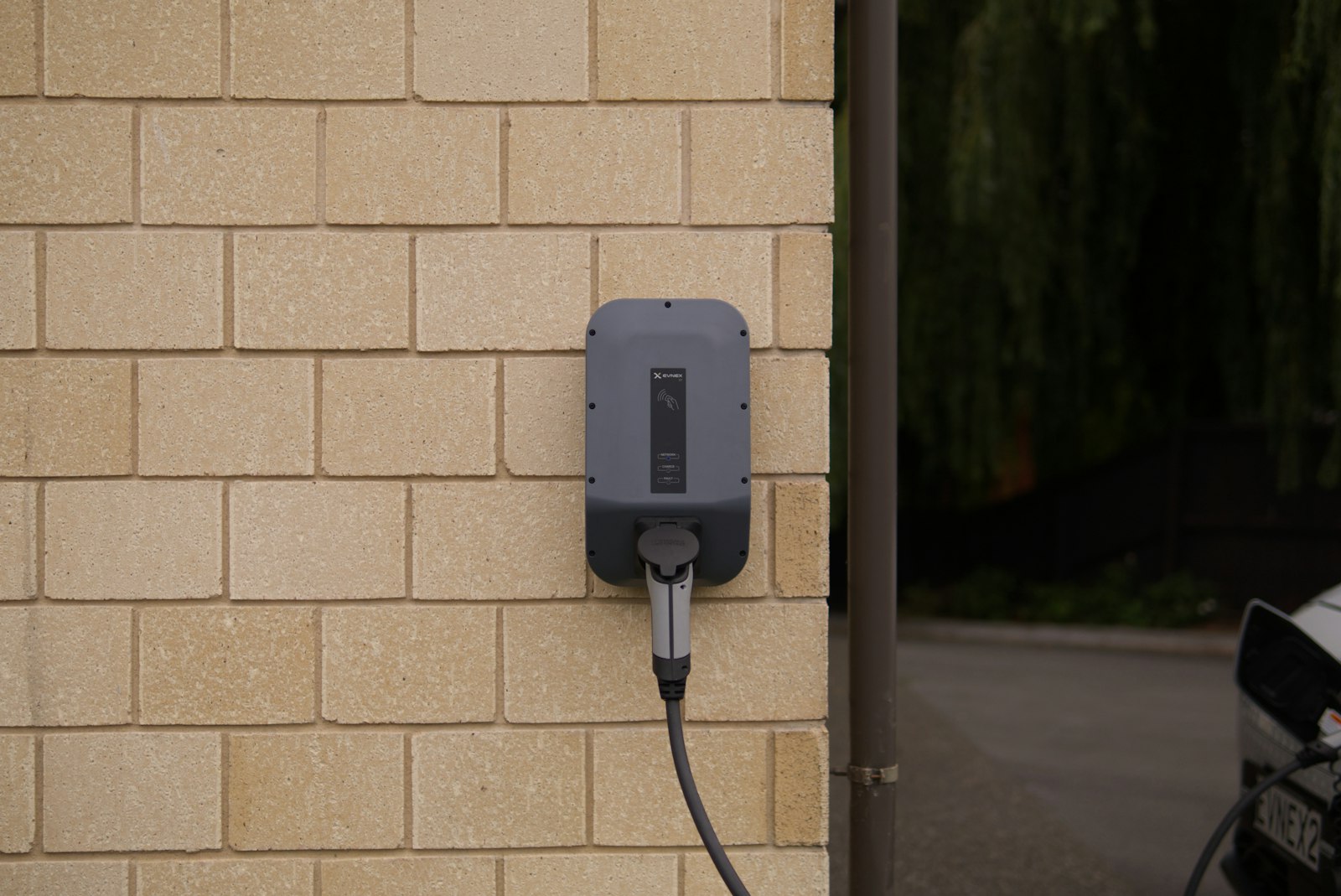
EV Charger Installation in San Angelo
EV charger installation in San Angelo usually means one new 240 volt circuit from your panel to the garage or driveway. A licensed electrician checks that the panel can carry it, sizes the circuit to the charger, pulls the City permit and gets it inspected.
- Panel labeled when done
- Written price before work starts
- City permit pulled and inspected
Most people looking into this already have the car and want it full every morning. The questions are how fast you need it to charge, whether to hardwire a charger or put in a NEMA 14-50 outlet, and whether your panel has room. Start with the calculator: it shows what each charger size means for your battery.
- Typical installed cost
- $500 to $2,000
- Common setup
- 48 A charger on a 60 A circuit
- City permit
- $100 base fee + work
- Federal 30C credit
- Ended June 30, 2026
Assumes 90% charging efficiency and about 3.5 miles per kWh. Your car's onboard charger can cap the speed.
Level 1 vs Level 2 Charging at Home
| Level 1 | Level 2 | |
|---|---|---|
| Power source | Regular 120 volt outlet | 240 volt dedicated circuit |
| Typical power | About 1.4 kW | 3.8 to 11.5 kW |
| Range added per hour | About 4 to 5 miles | About 12 to 36 miles |
| New wiring needed | Usually none | Yes, plus a City permit |
| Works for | Plug-in hybrids, short commutes | Most battery-electric cars |
Range figures use the same assumptions as the calculator above.
A Level 1 cord plugged into the garage outlet is fine if you drive in town and park for 12 hours a night. If you drive to Abilene or Midland, or share one car between two drivers, Level 2 is what makes the car full by morning.
Hardwired Charger or NEMA 14-50 Outlet?
Hardwired wall charger
The charger is wired straight to its own circuit. It can run at 48 amps on a 60 amp circuit, which a plug-in cannot. The charger has ground-fault protection built in, so there is no separate GFCI breaker to trip. Best if the charger will stay on that wall.
NEMA 14-50 outlet
A 50 amp, 240 volt receptacle you plug a portable or wall charger into. Easy to swap chargers or take one with you. It tops out at 40 amps of charging, and under the National Electrical Code it needs GFCI protection, usually a 50 amp GFCI breaker.
San Angelo has adopted the 2020 NEC. That edition requires GFCI protection for receptacles up to 250 volts in a home garage (210.8) and for every receptacle installed for EV charging (625.54). Some plug-in chargers do not get along with a GFCI breaker and trip it, which is one more reason to hardwire.
Tesla and the NACS plug. Tesla’s connector is now an SAE standard, J3400, also called NACS, and most automakers have committed to it starting around the 2025 model year. The AC pins match J1772, so simple adapters work both ways. A Tesla Universal Wall Connector or any listed Level 2 charger with the right cable will work; the wiring behind it is the same.
Circuit and Breaker Size for a Level 2 Charger
EV charging is a continuous load, so the circuit is sized at 125 percent of the charger’s output. Charger amps times 1.25 gives the breaker. Tesla’s Wall Connector installation table shows the same math:
| Breaker | Max charging current | Power at 240 V |
|---|---|---|
| 60 A | 48 A | 11.5 kW |
| 50 A | 40 A | 9.6 kW |
| 40 A | 32 A | 7.6 kW |
| 30 A | 24 A | 5.7 kW |
| 20 A | 16 A | 3.8 kW |
Source: Tesla Universal Wall Connector installation manual, circuit breaker rating to maximum output.
Bigger is not always better. The car’s onboard charger sets the real limit, and some cars accept less than 48 amps. Check the rating in your owner’s manual before paying for a bigger circuit than the car can use.
Does Your Panel Have Room for a Level 2 Charger?
A 60 amp circuit is a big new load. Before anything is installed, the electrician looks at your service size, what is already on the panel (electric range, dryer, water heater, heat strips, central AC) and whether there are spaces for a two-pole breaker. Then there are three ways it usually goes:
- It fits. If the load calculation shows room, the charger gets its own breaker at full size.
- Turn the charger down. Many wall chargers, including the Tesla Wall Connector, can be set to 32 or 40 amps at install on a smaller breaker. Over an 8-hour night, 32 amps still adds roughly 190 miles by the calculator’s assumptions.
- Add load management. A listed load-management device watches the whole house and slows or pauses charging when the AC, oven and dryer are all running. It can avoid a service upgrade.
If the panel is full, a fuse box, or an older 100 amp service, the charger may be the job that finally forces an upgrade. That is a separate project, typically $1,400 to $4,000; see panel upgrades in San Angelo. If you have a Federal Pacific panel, deal with that first.
Attached Garage, Detached Garage or Driveway
- Attached garage, panel on the garage wall. The simplest install, with the shortest wire run.
- Attached garage, panel across the house. The cable goes through the attic or crawl space. Distance adds wire and labor.
- Outdoor or driveway. The charger needs an outdoor-rated enclosure and a sensible spot for the cable to reach the charge port without crossing a walkway.
- Detached garage or shop. Usually a trench and conduit, or a feeder to a subpanel if the building needs other circuits too. Building a new garage or shop? Plan the charger circuit with the new construction wiring.
EV Charger Installation Cost in San Angelo
| Item | Typical range |
|---|---|
| Level 2 charger installed, short run, panel has room | $500 to $2,000 |
| Electrician labor alone | $400 to $1,200 |
| Level 2 charger, the unit itself | $300 to $1,000+ |
| City of San Angelo electrical permit | $100 base + work |
| Panel upgrade, if needed | $1,400 to $4,000 |
Typical ranges from Angi’s EV charger cost guide and the City of San Angelo fee schedule effective January 22, 2026. Not a quote; your written price follows a look at your panel and the route.
The price moves with distance from the panel, whether the wire runs through finished walls, and whether a GFCI breaker or load-management device is needed. For what electricians charge per hour here, see electrician cost in San Angelo.
Tax Credits and Electricity Plans for Home Charging
The federal Alternative Fuel Vehicle Refueling Property Credit (Section 30C) used to cover 30 percent of a home charger, up to $1,000, in eligible census tracts. The One Big Beautiful Bill Act ended it early: the IRS says you can’t claim it for property placed in service after June 30, 2026. A charger installed now does not qualify.
San Angelo is in the AEP Texas North service area and the market is deregulated. AEP Texas owns the wires and meter; you buy electricity from a retail electric provider you choose. Some providers sell plans with free or cheaper overnight hours aimed at EV owners, such as TXU Energy’s Free EV Nights. Compare plans for your address at Power to Choose, the Public Utility Commission of Texas shopping site, and read the fine print on the daytime rate.
EV Charger Installation Questions
How much does EV charger installation cost in San Angelo?
A Level 2 charger installed on a short run from a panel with room typically costs $500 to $2,000. A long run, a detached garage or a panel upgrade adds to that.
Do I need a permit to install an EV charger in San Angelo?
Yes. The City of San Angelo requires an issued electrical permit for all electric work inside city limits, and a new 240 volt circuit is inspected. The permit is a $100 base fee plus a charge for the work.
What breaker does a Tesla Wall Connector need?
For full 48 amp charging it needs a 60 amp circuit. It can be set lower at install: 40 amps on a 50 amp breaker, 32 amps on a 40 amp breaker, and so on.
Does a NEMA 14-50 outlet in the garage need a GFCI breaker?
Yes. San Angelo uses the 2020 National Electrical Code, which requires GFCI protection for 240 volt garage receptacles and for all receptacles installed for EV charging.
Will I need a panel upgrade for an EV charger?
Not always. Some homes have room, a charger can be turned down to fit, and a load-management device can pause charging when the house is busy. An older full panel or a 100 amp service may need an upgrade.
Is there still a federal tax credit for a home EV charger?
No. The Section 30C credit does not apply to chargers placed in service after June 30, 2026.
Can I just charge on a regular outlet?
Yes, at Level 1. A standard 120 volt outlet adds about 4 to 5 miles of range per hour, which works for plug-in hybrids and short daily driving.