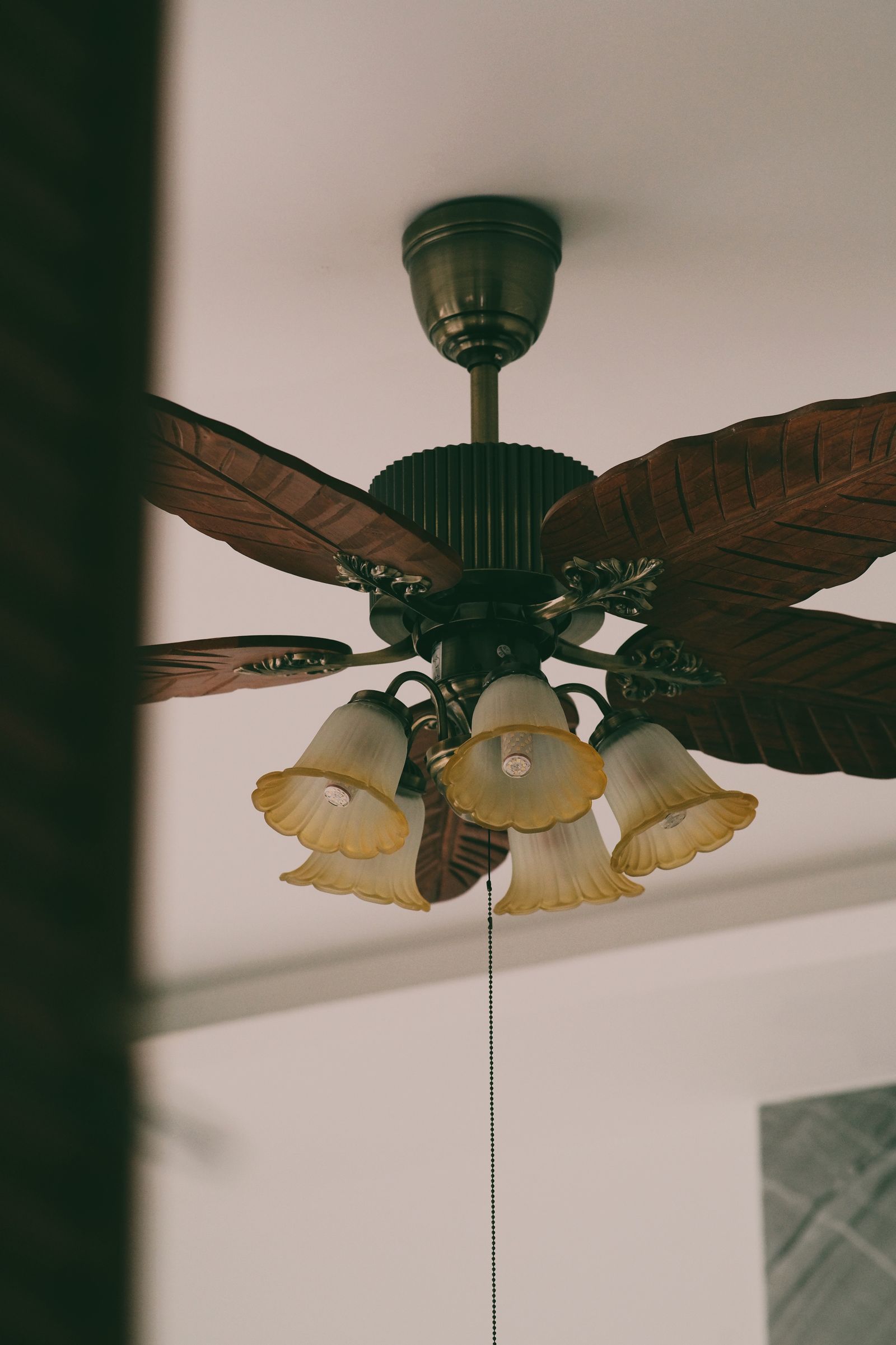
Ceiling Fan Installation in San Angelo
Ceiling fan installation in San Angelo for new fans, replacements and fans going up where a light used to be. The fan goes on a box rated to hold it, wired so the switches do what you expect.
- Clean job site when done
- Free estimate, no obligation
- Written price before work starts
A ceiling fan looks like a simple swap, and sometimes it is. What turns it into an electrician’s job is what you cannot see from the floor: whether the box in the ceiling can hold a heavy fan that spins and shakes, and whether the wires can run the fan and the light separately.
What Size Ceiling Fan Does Your Room Need?
Pick the size before you buy. Blade span is set by the floor area, and the downrod is set by the ceiling height. The U.S. Department of Energy says fans work best with blades 7 to 9 feet above the floor and 10 to 12 inches below the ceiling, and a 36 or 44 inch fan cools rooms up to about 225 square feet.
Blades must sit at least 7 feet above the floor. Keep them 18 inches from walls.
What a Ceiling Fan Installation Involves
Check the box and what holds it
The National Electrical Code only allows a fan to hang from a box listed for fan support. A box that carries a fan over 35 pounds must be marked with the weight it can hold, and no box may carry more than 70 pounds. A light box with no fan-support marking gets replaced.
Add a brace if there is no joist
Between joists, an expanding fan brace goes in through the hole or from the attic and the new box hangs from it.
Sort out the wiring
Separate fan and light control needs an extra wire from the switch box. If it is not there, the electrician runs it from the attic or uses a receiver in the fan canopy.
Hang, balance and test
Downrod, motor, blades and light kit go up per the maker’s instructions. Then the fan is run at every speed, balanced if it wobbles, and set to the right direction for the season.
Installing a Ceiling Fan Where a Light Was
This is a common request in older San Angelo homes. A 1960s or 1970s bedroom often has a single ceiling light on a wall switch, so power is already there. The catch is the box: light fixtures weigh a few pounds and do not move, and the box behind them often was not made to carry a fan.
Older ceilings can hide other surprises, such as aluminum branch wiring or circuits with no ground wire. If the electrician opens a ceiling and finds either, they tell you and price the fix in writing before going further.
Wall Switch, Remote or Wall Control?
| Setup | What the wiring needs | Good for |
|---|---|---|
| One switch, pull chains for speed | Existing 2-wire switch cable | Simple swaps, lowest cost |
| Two switches: fan and light separate | 3-wire cable (extra conductor) from the switch box | Bedrooms and living rooms |
| Wall-mounted fan and light control | Depends on the control; some need the extra conductor | Speed control without a remote to lose |
| Handheld remote | Receiver in the canopy; works on 2-wire | High ceilings, no new wire run |
| Switches at two doors | 3-way switch wiring | Large rooms, rooms with two entries |
If a light used to work from two switches, the fan can too, but the 3-way travelers have to be sorted out first. Our guide to 2-way and 3-way switches explains how those circuits work. Remotes are handy, but when they stop responding it is usually the battery, the pairing or the receiver; the Hampton Bay remote troubleshooting guide covers the common fixes.
High Ceilings, Sloped Ceilings and Patio Fans
Vaulted ceilings need a longer downrod and an angled mount. Fan makers such as Hunter call for angled mounting on vaulted ceilings, with the canopy turned so its label faces the peak. Check the fan’s maximum slope before you buy. Ceilings over 12 feet usually mean a taller ladder or scaffold and a longer job.
For porches and patios, the rating matters as much as the style:
- Covered porch
- Damp-rated fan
- Open pergola or uncovered patio
- Wet-rated fan
- Edge of a covered porch
- Wet-rated if wind drives rain in
Dry-rated fans are made for indoor use only. A new outdoor fan location usually means a new wire run and a weatherproof box.
Ceiling Fans in a San Angelo Summer
West Texas summers are long and hot. In July 2022 the National Weather Service recorded an average high of 103.5°F at San Angelo, the warmest month on record there, with 29 days at 100°F or more. A fan does not cool the air. It moves air across your skin, which the Department of Energy says lets you raise the thermostat about 4°F with no loss of comfort when the AC is running.
- Turn fans off in empty rooms. They cool people, not rooms.
- In summer, run the fan counterclockwise (looking up) so it pushes air down.
- No reverse switch on the motor? See how to change fan direction without a switch.
Ceiling Fan Installation Prices in San Angelo
| Job | Typical price |
|---|---|
| Install or replace a fan, wiring in place (labor) | $100 to $375 |
| New fan location with new wiring (fan included) | $250 to $700 |
| Add a new wall switch | $100 to $300 |
| Outdoor fan with new wiring (labor) | $200 to $1,000 |
| Fan-rated mounting kit (parts) | $10 to $20 |
Typical Texas and U.S. ranges from published cost guides (Recommended Dallas electrician cost guide, HomeGuide), not quotes.
A fan swap where the box is already fan-rated sits at the low end. Replacing the box, adding a brace or running a second conductor for separate switches moves it up. For rates and service call fees on other work, see the electrician cost guide.
Questions About Ceiling Fan Installation
Can a ceiling fan go where a light fixture is now?
Usually yes, since power and a switch are already there. The box almost always needs to be swapped for one listed for fan support, with a brace if it is not fixed to a joist. Plan on that unless the box is marked for fans.
How low can a ceiling fan hang?
The blades must be at least 7 feet above the floor. On an 8 foot ceiling that means a flush or hugger mount. The Department of Energy recommends 7 to 9 feet for the best airflow.
Can I get separate switches for the fan and the light?
Yes, if there is an extra conductor between the switch box and the ceiling, or one can be run through the attic. Without it, a remote or a wall control that talks to a receiver in the fan gives you separate control on the existing wires.
How long does a ceiling fan installation take?
A straight replacement on a good box is often one to two hours. A new location with new wiring runs about two to four hours, longer on high or sloped ceilings.
Should I buy the fan before the install?
You can, but run the room through the size finder first and check the downrod length for your ceiling. Open the box before install day so missing parts or a too-short downrod show up before the old fixture comes down.
Can I use an indoor fan on my covered patio?
No. Outdoors, use a damp-rated fan under a solid roof and a wet-rated fan anywhere rain can reach it.
Ready to put a fan up?
Tell us the room, ceiling height and whether there is a light there now.